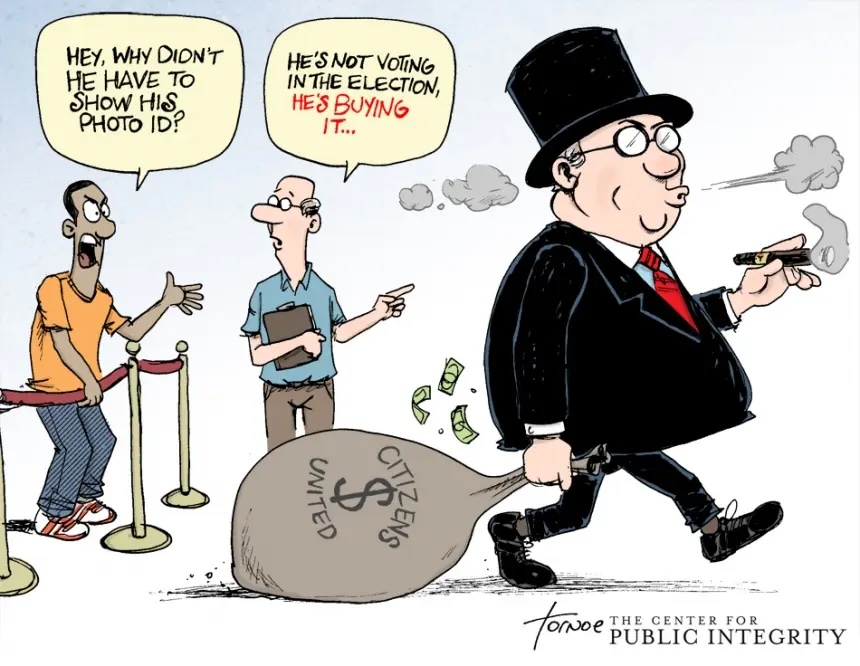

There’s only a few issues on which I’ve worked during my career that will stick with me. SB2471 Relating to the Powers of Artificial Persons is one of them.
Fuck Citizens United
The Supreme Court issued its ruling on Citizens Untied v. FEC on January 21, 2010. The ruling essentially said limits on corporate spending in elections is a violation of the First Amendment of the U.S. Constitution. For those just coming out of a coma, living under a rock, or in some remote wilderness, that’s the same date the crumbling of our democracy began to accelerate.
Since the ruling, billions of dollars in dark money have flooded our election system corrupting our democracy for the benefit of a handful of wealthy individuals and for-profit corporations.
Today, 16 years later, we can see the very real impact of that ruling. President Donald J. (which I’m pretty sure stands for “jackass”) Trump has done untold damage to our government structures, the principles of due process and equal protection, and to our economy.
Corporations and the people who own and/or run them, have made out like bandits in the intervening years. And while their wealth has exploded, the rest of us have seen our wages stagnate, our housing become more expensive, and the fabric of our society ripping apart at the seams.
The U.S. Supreme Court once opined that money is not a corrupting influence on our political system. Boy did they fucking get that one wrong.
Almost from the day of the ruling, I’ve been passionate about this issue.
Talk of a constitutional amendment began almost immediately among those who knew what was coming. Many of us knew the herculean effort that would take. And despite genuine efforts across the country, no one in power really took it seriously. Neither the ruling nor efforts to undo it.
After a few years of co-authoring resolutions for the Democratic Party of Hawaiʻi and the state legislature, I eventually shelved any hope we’d fix it. So I turned my attention to other pressing issues: minimum wage, marriage equality, paid family leave, and other issues that impact the daily lives of friends and neighbors.
The Dusty Legal Framework That May Just Change Everything
Fast forward to November 2025. I’d been working at the ACLU of Hawaiʻi for a little over two years. Just a year earlier I had closed another chapter in my life by undoing the Hawaiʻi Constitutional Amendment that had chilled same-sex marriage for nearly 30 years.
I don’t remember now from whom it came, but I received an email with a link to a report from the Center for American Progress (CAP) entitled, The Corporate Power Reset That Makes Citizens United Irrelevant. Like some maneuvering of destiny, I saw renewed hope. And at a time when I was working for the same organization that a decade and a half earlier I had boycotted because of their support for Citizens United.
I think I read it twice before digging into the footnotes and then proceeding to my own research. I learned that efforts were already underway in Montana to take this approach to the voters via a ballot question and amendment to their state constitution. Could this thing, appropriately named the Corporate Power Reset (CPR), be the solution? Did we finally have a chance to undo that disastrous ruling without a wholly new and progressive court? Could we fix this disaster without a constitutional amendment?
I was hooked.
It didn’t take me long to connect with the report’s author, Tom Moore. After he explained it all to me again in even more plain language, it didn’t take long for the beginnings of a plan. Hawaiʻi would try, too.
Relating to the Powers of Artificial Persons
Now that I was working for the same constitutional defender whose membership I had given up years before, I hoped for the opportunity for the ACLU to redeem itself. Sadly, upon pitching the approach to them, I and the CPR were quickly dismissed as a novel, flawed, and unconstitutional wishful thinkers.
Though disappointed, I remained undeterred. I advocated for the Hawaiʻi affiliate to take up the issue independent from ACLU National. I was again rebuffed. Luckily, our Hawaiʻi Executive Director saw the possibility in the CPR and gave me the autonomy to take up the issue on my own. As Josh Frost, the person.
I am so grateful to Salmah Rizvi for giving me the space achieve this accomplishment.
With Tom’s supervision and editorial authority, I drafted a bill. It wasn’t going to be a constitutional amendment, like Montana. I’d just scraped out a narrow victory on a widely supported constitutional amendment ballot issue and was neither eager to take up that effort again nor confident a ballot question on this would be successful. We took our pitch to the legislature and at the law.
My first stop was Senator Karl Rhoads.
I met Karl for the first time all the way back in 2009. I was in my first job at the Capitol and Karl was I believe a sophomore in the Hawaiʻi House of Representatives. We had bonded over our matched hatred of Citizens United.
We’d go on to work on countless issues together, but it all started with Citizens United. He of course had questions. I did my best to answer the ones I could, but eventually I connected him with Tom at CAP and it didn’t take long. Within a day or two, we had a primary sponsor in the Senate (similar but not identical bills were already drafted and sponsored in the House).
On January 22, 2026, SB2471 was introduced in the Senate.
We started quietly. I had talked with a few friends and fellow advocates about the bill. And though we were all excited, as cautious optimists, we laid low and didn’t push too hard.
On February 3rd, Senator Jarrett Keohokalole, Chair of the Senate Committee on Commerce and Consumer Protection, heard the bill. Thoughtfully and with intention, Senator Keohokalole moved the bill out of his committee and would go on to champion the bill’s ultimate passage out of the legislature.
With quiet intention, and one or two stumbling blocks, we moved the bill through the Senate will little fanfare and universal support.
The House wasn’t so easy. Chair Scot Matayoshi similarly moved the bill along quickly and with no spotlight. Knowing the House is often more cautious than the Senate our expectation was met when SB2471 appeared to stall. The Judiciary and Hawaiian Affairs Chair, tasked with shepherding (or not) a massive list of referred bills, weighed carefully the pros and cons of the practical implications of the bill.
In the end, courage won out over doubtful demons. Chair David Tarnas met the moment, heard and passed the bill.
Something none of us really thought was possible was suddenly about to happen; a possible end to Citizens Untied was about to clear both legislative chambers. And it did.
The bill passed the House with two mere no votes.
Celebrate Community
By the time SB2471 was heading to conference, the cat was out of the bag. Slivers of opposition had begun to form and it wouldn’t be long before slivers would become growing cracks threatening to become chasms.
To the rescue came friends and good government advocates. Up to that point, I had been intentionally nudging the bill quietly along with a few friends who supported my effort. But the bill was out. People were talking and doubts grew loud.
Without the help of this intrepid group of tireless advocates, it’s likely I’d be writing a very different post. Or simply no post at all.
They rallied the public. Organized press events. They advocated and talked to the press, as I was hiding from the spotlight out of respect for my supportive Executive Director. They helped keep legislative leaders on track and took advantage of political relationships I may not have had.
With Tom supporting tirelessly from afar, we got it done. A compromised, but not fatally so, SB2471 was sent back to both chambers as a Conference Draft.
And then something perhaps even more astonishing happened. This idealistic team got the bill “fixed” with floor amendments in both the House and Senate. A rare, though not uncommon, occurrence.
I Cried
It is rare that I emote. It’s just the way my brain is wired.
Add to that years of hardening myself to the realities of legislative advocacy. Policy wins and losses don’t affect me in any substantial way. Wins bring smiles and losses bring frustration. But both are short lived; on to the next.
There only two exceptions.
The first took place on the night of November 8, 2013, when the House passed same-sex marriage. The success had been five years in the making and my sole policy passion just as long. The man who had encourage my participation (including as the only straight co-founder of what would for a time be the largest LGBTQI+ organization in the State) had died before he saw his dream made reality.
I remember crying on the steps of the Capitol with thousands of others who had gathered in support. And then, just like now, I stood out of the spotlight.
The second came on May 8, the final day of the 2026 legislative session.
When we started, as with so many other issues, I had no expectations. Succeed or fail, I would do what I could to move the bill along. There were so many moments in the last couple of weeks when I thought we’d come to the end of the road.
But the community grew and the public showed signs of life. And as the voices of opposition grew louder, so did mine. Ours. I am so grateful for and proud of everyone who showed their support. Phone calls, emails, posts on social media. It wasn’t my bill anymore; it was ours.
Similar to same-sex marriage, the community rallied. Now, as then, what started small, grew. And the legislature did what was right.
I am so grateful and appreciative to the team that rallied. The team that brought allies I couldn’t and rallied the public in a way I never would have been able to on my own.
Thank you:
Kris Coffield, Founder and President of Imua Alliance
Nate Hix, Director of Policy and Advocacy at the Hawaiʻi Public Health Institute
Aria Castillo, Reclaiming Democracy Program Director at Hawaiʻi Alliance for Progressive Action
Evan Weber, Co-Founder and Managing Director of Our Hawaiʻi
Camron Hurt, State Director at Common Cause Hawaiʻi
And so many others.
But as is always the case, the work is not done. It’s off to ensure Governor Green signs the bill and Hawaiʻi makes history again.